A Bogota Coffee Day Trip, Hour by Hour
Short answer. A farm day runs from a pickup between 6:30 and 9:00 to a drop-off between 15:00 and 18:00. Roughly four to five of those hours are in a vehicle, two to four are on the estate, and one is lunch. Nothing about it is rushed except the traffic.
Total tour length tells you almost nothing, because most of it is the road. This is what the hours actually contain, taken from the operators' own stop lists rather than from marketing copy, so you can see where your day goes before you commit it.
06:30–09:00 — how the day starts
Two ways, and it is worth knowing which you have bought. About half the farm departures collect you from your own address, one of them from El Dorado airport. The rest meet at a named place: The Cranky Croc Hostel on Calle 12d in La Candelaria, the Bogota Marriott on Avenida El Dorado, or a cafe in Chapinero.
The early ones are early for a reason. One operator states that most of its tours depart before 7:00, and the road that takes ninety minutes at dawn takes three hours at nine. If you can choose, choose early.
The first hour — getting out of the city
Traffic, then the southern or western edge, then the drop. Guides use this hour rather than waste it: Colombian history, the neighbourhoods you are passing, the country's relationship with the crop you are going to see. Travellers write about it as one of the better parts of the day, which is not what you expect of a van.
The second hour — a thousand metres down
The temperature climbs, the cloud lifts off the ridges and the vegetation changes completely. One operator describes leaving 2,600 metres to find a warmer climate, and you feel it before you see it. This is the best window of the day for photographs, and a couple of departures build in a break or a photo stop here.
Some routes pass through Silvania or Fusagasuga on the way. One stops at a coffee trading shop in Silvania to watch the day's buying happen, which is a piece of the business no farm shows you.
Mid-morning — arrival, and breakfast on the farms that do it
On the hands-on smallholding the day starts with a campesino breakfast and coffee brewed in an olleta on the stove, then a short introduction to the farm. Half an hour, roughly. Elsewhere you get coffee and a welcome, and go straight to the slope.
Late morning — the field walk
An hour, give or take, on planted ground. You learn to read a cherry, you pick if the season allows, and you climb a bit. It is uneven and often damp; several listings ask for a moderate level of fitness and mention rural paths, and none of them is a hike.
Which month you are in decides whether you fill a basket or plant a seedling. One departure has arranged its farms so that picking is available all year.
Midday — the part the day is actually for
The depulper, the fermentation tanks, the drying beds and usually the roaster. This is the sequence that turns a drive into an education, and it is where the estates differ most: two hours covers it briskly, four covers it properly, and the two specialty estate visits give you seven or eight and add a laboratory.
Every stage, in order is worth ten minutes before you go, because the vocabulary makes the guide's answers land.
Early afternoon — lunch, or not
On most full farm days, a plate cooked in the farm kitchen and eaten in the open air, and travellers rate it as highly as the coffee. On the ones that exclude food it is a roadside stop or nothing, and on one it is an optional extra bought at the farm. It is a single line on the listing and it changes the shape of your afternoon.
Mid-afternoon — the tasting
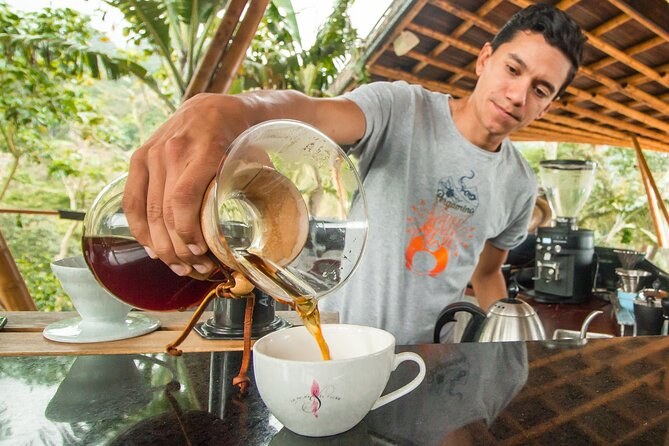
What the farm grew, brewed in front of you. On the hands-on day you grind it and make it yourself on a French press. On the specialty estates it is a structured cupping. On the general farm days it is a good cup with an explanation, and on one of them a coffee liqueur the estate makes itself.
15:00–18:00 — the road home
The slowest part of the day and the only thing travellers reliably complain about. Two to three hours is normal; one return leg ran to nearly four in heavy traffic. It is Bogota rather than any operator, every guide plans for it, and it is the reason not to book anything for the evening.
What happens if the day runs late?
It usually does, by half an hour or so, and it is almost always the return. Operators build slack into the outbound leg because the pickup window is theirs to control and the evening traffic is not. Nobody cuts the farm short to make up time; they take the road slower instead.
Two things follow. Do not book anything for the evening, and do not take a farm day on the morning of a flight. If you are flying out that day, the two-hour city workshop is the version that fits, because it returns you to the centre by lunchtime.
Where do the stops actually happen?
The routes are not identical and the stop lists are worth reading. Some run through Silvania and Fusagasuga, one of them stopping at a coffee trading shop to watch the day's buying. One takes in Zipacon, an old colonial town on the Sabana, for twenty minutes of street and cornbread. One builds in a viewpoint over Tequendama Falls, where the Bogota River goes 132 metres off a cliff.
Those stops are not filler. They are why two departures to broadly similar farms feel like different days, and they are stated on the listings rather than promised vaguely. The route towns are covered here.
What does the shortest version look like?
Two hours in Chapinero: three specialty rooms, a tasting at each, a walk of under a mile between them, and a cupping sheet. It starts at 10:00 and returns you to the city centre by lunchtime. It is a different day rather than a compressed one, and it covers what a farm cannot.
How the formats compare, hour for hour
| City workshop | Shared farm day | Specialty estate day | |
|---|---|---|---|
| Leaves | 10:00 | 6:30 to 9:00 | 8:00 |
| In a vehicle | None | 4 to 5 hours | 4 hours |
| On site | 2 hours, three rooms | 2 to 4 hours | 7 to 8 hours |
| Food | Coffee only | Lunch on most | Lunch included |
| Home by | Midday | 16:00 to 18:00 | 18:00 |
| Price | $49 to $60 | $81 to $130 | $177 to $221 |
Useful tip. Ask the operator for the pickup time in writing when they confirm. Several confirm the exact time only the day before, and a 6:30 start you were not expecting is a bad surprise. How the pickups work.
Is it worth the four hours in a vehicle?
If the crop interests you at all, yes, because there is no shorter route to it. Nothing between the seedbed and the drying bed exists inside Bogota, and the drive is the price of seeing it. The guides make the road part of the day rather than an interval, which is most of why the format works.
If the answer is no, do not force it. A coffee farm tour from Bogota in the city is two hours, costs fifty dollars, and teaches the half of the subject that comes home with you.
Does a private departure change the clock?
A little, and not where you would expect. Private days do not go faster — the road is the road — but they collect you from your own address, they wait for you, and the pace on the estate is yours rather than the group's. On one of them the whole day is a car, a bilingual guide and seven hours on a specialty estate.
Where it genuinely helps is at the two ends. No meeting point at dawn, no waiting for a last traveller, and a drop-off at your door instead of at a hostel across the city. What a private day actually buys goes through the rest.
What to do with the evening
Nothing ambitious. You will be back somewhere between four and six, you will have eaten a large lunch, and you will smell faintly of a van. La Candelaria and Chapinero both have enough within walking distance that you need not plan anything, and what else fits around a coffee day covers the rest of the trip. Every departure and its real hours sit on Bogota Coffee Tours.
Frequently asked questions
How long is a Bogota coffee tour really?
Eight to fourteen hours door to door for a farm day, of which four to five are in a vehicle. City tastings are two to three hours. Read the duration field rather than the title, because one listing says half-day and describes nine hours.
What time will I be picked up?
Between 6:30 and 9:00, confirmed by the operator after booking and often only the day before. One operator warns that most of its departures leave before seven.
How much of the day is driving?
About half. The nearest farm is ninety minutes each way and the furthest is three hours, and the return leg is slower than the outbound because of Bogota traffic.
Can I get back in time for an evening flight?
Not reliably. Drop-off is anywhere between 15:00 and 18:00 and the return leg is the least predictable part of the day. A two-hour city workshop in the morning is the safe option on a departure day.
Do I get free time on the farm?
Some, usually around lunch and the tasting. The field walk and the processing tour are guided, because you are on a working business rather than in a park.
Is there anywhere to sit during the tour?
On most, yes, at breakfast and lunch. One traveller on the falls day asks specifically for seating during the two-hour guided part, which is fair warning if standing that long is difficult for you.
Days that use the hours well