What You Learn on a Bogota Coffee Tour
Every farm day sells the same thing in different amounts: the road from a seed to a cup. Twelve stages, in the order they happen, so that when a guide says "washed" or "parchment" on a slope in Cundinamarca you already know what they mean.
Before the plant: why the farm is not in Bogota
Arabica wants warmth, rain and altitude in a narrow band — roughly 1,200 to 2,000 metres in Colombia. Bogota sits at about 2,640, which is above the band and too cold with it. That single fact is why every farm visit here begins with a drive downhill, and why the air changes noticeably somewhere around the first hour.
Altitude is not a detail. Slower ripening at height concentrates sugars and acids in the fruit, which is why high-grown coffee tastes brighter. It is also why the good farms sit on slopes steep enough to make the walking part of the day real.
The twelve stages, in order
- The seedbed. Beans are germinated in shaded nursery beds before anything goes in the ground. You will see trays of seedlings the size of a hand.
- Planting out. A young tree goes into the slope and takes about three years to bear its first useful crop — a detail one reviewer says stayed with him longer than anything else that day.
- Flowering. White blossom, briefly, smelling of jasmine. It sets the timetable for everything that follows.
- The cherry. Green, then yellow, then red. Ripeness is judged by colour and by feel, and picking green is the commonest way to ruin a lot.
- Picking. By hand, selectively, tree by tree, several passes per season. This is the part visitors do themselves, basket on the hip.
- Depulping. The skin and flesh come off within hours of picking, in a machine that looks agricultural and sounds worse.
- Fermentation. The beans sit in tanks, still slick with mucilage, while microbes strip it. Hours matter here; this is where a lot of the flavour is decided.
- Washing. The classic Colombian step, and the reason "washed" appears on so many bags. The beans come out clean and pale.
- The drying beds. Patios or raised beds, raked by hand, a week or so in good weather. Rain at this stage is a genuine problem, which is why beds are covered.
- Parchment and milling. A papery husk comes off to leave green coffee. Most farms sell at this point; the estates you visit usually do not.
- Roasting. Where the flavour you actually recognise is built, in minutes rather than months. Some farms roast on site; some send it to Bogota.
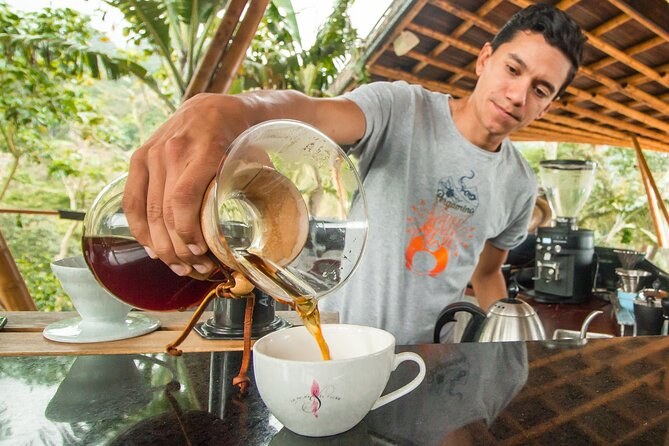
- Brewing and tasting. Olleta on a stove, French press, pour-over or espresso, depending where you are standing.
Washed, natural or honey — the choice that changes the cup
The stages between picking and drying can be run three ways, and it is the single biggest thing a farm decides. Guides will name the method; this is what each one means for what you drink.
| Method | What happens to the fruit | What it tends to taste like | Where you meet it |
|---|---|---|---|
| Washed | Pulped, fermented, then washed clean before drying | Cleaner, brighter, more acidic | The Colombian default, on most of these farms |
| Natural | Dried whole, fruit still on the bean | Heavier, sweeter, more berry | Specialty lots, on the estates with a laboratory |
| Honey | Pulped but not washed; some mucilage left on | Between the two, rounder body | Small experimental lots |
What "specialty" actually means
It is a score, not a mood. Coffee is cupped and graded, and 80 points and above on the hundred-point scale is the line. Two of the estates you can reach from Bogota work at that end deliberately, with their own laboratory and named lots, and one of the city workshops teaches you the scoring sheet they use.
Varieties you will hear named
Castillo and Colombia are the two bred for leaf-rust resistance and are what most of the country grows. Caturra is the older, sweeter, more fragile one that keeps turning up on smaller farms. Beyond those sit the varietals a specialty estate plants for flavour rather than yield, and the guide will tell you which rows are which if you ask.
Reading a bag afterwards
By the end of a farm day the label on a bag of Colombian coffee stops being decoration. Region, altitude, variety, process and roast date are five things you can now interpret, and the last of them is the one most people ignore and should not. Buy recently roasted coffee and grind it late.
Where you learn this changes what you take away: a finca teaches the plant, a city cupping room teaches the cup, and the month you come in decides whether you pick or plant. Every departure is listed on Bogota Coffee Tours.