What to Expect on a Bogota Coffee Tour
A farm day from Bogota is longer than it sounds and better than it looks on paper. Here is the whole thing by the clock, from a pickup in the dark to the crawl back into the city, so nothing about it surprises you.
Your day, hour by hour
- 06:30–09:00 — collection. Nine departures come to your address; the rest meet at a named place. One operator warns that most of its tours leave before seven, and it means it.
- The first hour — getting out. Bogota traffic, then the city edge, then the descent. Your guide fills this with the country rather than the coffee, which is what stops the drive being dead time.
- The second hour — the drop. A thousand metres down. The temperature climbs, the cloud lifts off the ridges and the vegetation changes. This is the best window of the day for photographs.
- Mid-morning — arrival and breakfast. On the farms that include it, a campesino breakfast with coffee brewed in an olleta on the stove. On the ones that do not, coffee and an introduction to the estate.
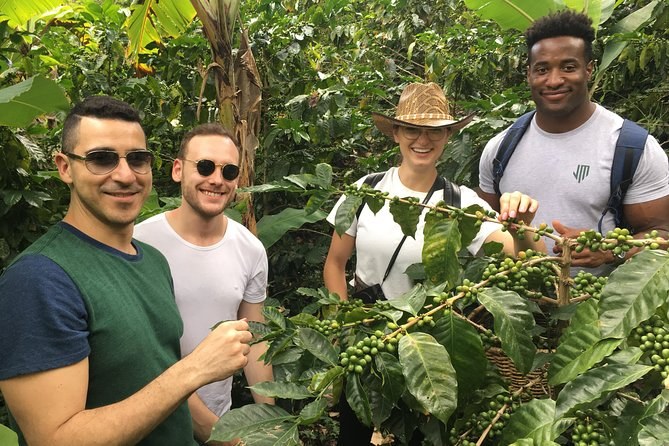
- Late morning — the field walk. An hour or so on planted slopes, identifying ripe cherries and picking them if the season allows. Uneven ground, some climbing, nothing technical.
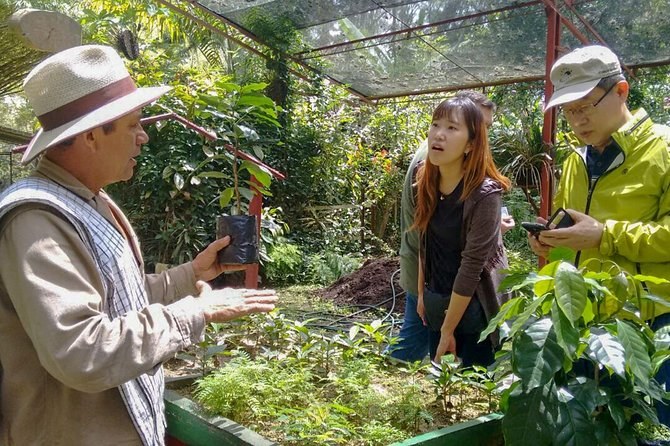
- Midday — the process. The depulper, the fermentation tanks, the drying beds, and usually the roaster. This is where the day earns its length.
- Early afternoon — lunch. Cooked on the farm on most of the full-day departures. Where it is not included it is either an extra or a stop on the road, and the listing tells you which.
- Mid-afternoon — the tasting. What the farm grew, brewed in front of you, usually with a grind and a brew method to compare.
- 15:00–18:00 — the road back. The slowest part of the day and the only thing reviewers reliably complain about. One traveller's return leg ran to four hours in heavy traffic.
What the drive is really like
Comfortable, and long. Vehicles are vans or cars rather than coaches, several are air-conditioned, and the roads are paved the whole way to every one of these farms. The distance is not the issue; the exit from Bogota is. Leaving before seven can be the difference between ninety minutes and three hours.
If you are prone to motion sickness, sit forward and eat something before you go. The descent has switchbacks in it.
Know before you go
- Two travellers minimum, on two departures. Both refund in full if the minimum is not reached, so a solo booking is safe rather than risky.
- One tour is non-refundable. The coffee and chocolate walk marks its sale final. Everything else here refunds at 24 hours.
- Uneven ground on every farm. Several listings ask for a moderate level of fitness and mention rural paths. None of them is a hike.
- No wheelchair access. Not one operator describes its tour as wheelchair accessible. A few note that a stroller can be managed.
- Health notes on three listings. Two say the day is not recommended for travellers with heart conditions, and two flag back problems. Read the tour's own notes before booking.
- Cash in pesos. Every farm sells beans and most sell lunch. Cards are unreliable out there.
What to bring
| Item | Why | How much it matters |
|---|---|---|
| Closed shoes with grip | Planted slopes, often wet | Essential |
| A light rain shell | Nearly every departure runs rain or shine | Essential in April, May, October, November |
| Layers | You leave 2,640 m and arrive around 1,500 m | Essential |
| Sunscreen | Thin high-altitude light on the drive, open slopes on the farm | Important |
| Insect repellent | One reviewer's specific complaint on the cacao day | Important on the low farms |
| Cash in pesos | Beans, extras, lunch where it is not included | Important |
| A spare bag | Reviewers keep saying they under-packed for what they bought | Optional, and you will wish you had |
How long you actually get on the farm
Between two and eight hours, and the gap is the single most useful number when you are comparing departures. Two hours is a walk, a look at the mill and a cup. Four hours is the whole process without hurrying. Seven or eight, which two departures to one estate offer, is a cupping and a barista class on top.
Total tour length tells you almost nothing about this, because most of it is the road. An eight-hour tour can give you two hours on the estate or four, depending on whose it is, and both are honestly described on their own listings.
Getting back into the city
Slowly, most days. The return is the only part of a coffee day that draws complaints, and it is Bogota's traffic rather than anybody's driving: one traveller's four-hour return leg is the outlier, but two to three hours is normal in the late afternoon. Guides plan for it and the good ones use the time.
You will be dropped where you were collected, and on the pickup departures that means your own hotel. If you have an evening plan, make it a late one.
What you eat
On the farms that include food, better than you expect. Breakfast and lunch earn as much praise as the coffee does: eggs, arepas, soup, a plate of something cooked in the farm kitchen. Vegetarian and vegan requests are accommodated on several departures if you ask in advance, and one listing asks for dietary notes at booking rather than on the day.
Who a farm day does not suit
Anyone with under a full day free, anyone who cannot manage an hour on sloping ground, and anyone who was hoping for the Coffee Triangle — that is a different region and a domestic flight, not a day trip. If any of those is you, the two-hour city tasting rooms cover the same subject on flat pavement in one morning, and a coffee farm tours in Bogota is still worth doing on another trip.
What you leave with
A working idea of how the crop actually gets to a cup, which is the thing the day is for. Usually a bag of coffee, sometimes a photograph of yourself holding a basket, and on one farm a tree you planted that stays there. Reviewers who do not drink coffee say it was worth the day anyway, which is as good a test as any.
Every departure, with its hours and its inclusions, is on Bogota Coffee Tours. If you have not chosen a month yet, the calendar is the other half of this decision.
Farm days that collect you from your hotel